
In Short:
BetterBriefs’ view: marketers are often too quick to brief something new. If a campaign is still working, the better decision may be to keep building on it rather than start again.
- Most campaigns are retired long before there is evidence of genuine creative wear-out.
- Repeated use of strong campaign platforms, characters and distinctive assets can improve memory and effectiveness over time.
- Before briefing a new campaign, marketers should ask whether the strategy really needs to change—or whether the existing idea simply needs a fresh execution.
Why are marketers so obsessed with new things?
Our industry loves making new things. When advertising is required, our default position is to create something new. Right now, everyone is working faster than ever, but we’re creating mostly forgettable stuff. Ads, posts and campaigns are pushed out into the world, and we all move on to the next thing.
But what if the best thing you could do this year isn’t make something new, but keep running something you’ve already got?
Think of your favourite campaigns of the last 20 years. Chances are, you remember them because they ran longer than most. Now think of the ads you remember from childhood. They ran for years. How long did your last campaign run for? It's worth asking how long a campaign should run because the evidence points somewhere very different from current practice.
Longevity = fame
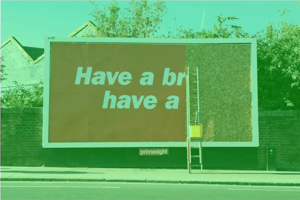
KitKat has been telling us to “Have a Break” since 1958. We’ve been told we “Should’ve gone to Specsavers” for over two decades. The Guardian is still mining the same independent-view-of-the-world idea it staked out 40 years ago. The most effective campaigns are often the ones that run longer than most.
Do ads wear out over time?
Rarely. If we’re afraid people will get bored of seeing our ads, we shouldn’t be as there’s plenty of evidence that proves the opposite. Analytic Partners analysed more than 50,000 ads and found only 14 showed genuine wear-out, meaning nearly all campaigns were retired while still working. Research by System1 reached the same conclusion, comparing star ratings of ads up to 19 years after release and finding little change over time. They also found that performance of some ads, especially those using recurring characters or slogans, actually improved over time. Kantar's analysis, based on around 20 years of ad tracking, also found no evidence that performance declines with time on air, concluding that strong creative can keep delivering results for as long as it runs.
Your campaign isn't worn out. You are.
It’s a different story for marketers, however. Their job makes them think about their brand, category, competitors, communications and ideas all day, every day. So when a marketer sees an ad, they can’t help but dissect it, analyse it and look for what’s new, processing it through System 2. This is the slow, deliberate, conscious part of the mind. The target audience isn’t doing any of that. They’re just seeing an ad, often while thinking about something completely different and processing it through System 1. This is the fast, automatic and intuitive part of the mind. What feels like unbearable repetition to a marketer still feels fresh, distinctive and memorable to the audience.
To be clear, we’re not suggesting brands should hold onto ideas and keep running campaigns that aren’t working. Nor are we suggesting that longevity trumps a change of strategy. There are plenty of good reasons to change direction. But there are also plenty of good reasons to stay the course.
The longer it runs, the better the briefs are
Another payoff of sticking with a campaign is that your briefs get better every year. The first brief for a new platform is the hardest one. You’re doing the heavy thinking from scratch, feeling around for what the idea even is. Once that work is banked, you don’t face the blank page again. Each brief becomes tighter, sharpened by what actually happened in the market. Your strategy becomes the foundation, and your focus to optimise execution.
The value of memorable devices
Running something for years doesn't mean it stops changing. But the platform should retain the things that make it memorable. System1 and Peter Field analysed 300+ campaigns in the IPA Effectiveness Awards and found that those with a recurring ’fluent device' (= a consistent character, format or asset held over years so audiences recognise it instantly) were 37% more likely to grow market share, 27% more likely to gain customers and 30% more likely to grow profit.
These aren’t small numbers. There’s real business value in assets like the Duracell Bunny, the M&Ms characters and Compare the Market’s meerkat. Same with audio mnemonics; McDonald’s “ba-da-ba-BA-BAAA” has been worming its way into our subconsciouses since 2003.
More often than not, it’s the campaign platform itself that does the heavy lifting. Snickers’ “You’re not you when you’re hungry” has allowed them to build on the same idea for 16 years, while still creating fresh executions. Same with Specsavers. Same with KitKat.
Change your default, not your campaign
Next time you sit down to brief an agency, the real question isn't what the new campaign should be. It's whether you should brief a new campaign at all, or keep the one you've already got. Put a few questions to yourself first:
- - Is this idea actually finished, or have I just looked at it a lot?
- - Has something genuinely changed in the business, the market or target audience that the current platform can’t stretch to cover?
- - Could what I want be a new execution of what we’ve already got, rather than a whole new thing?
- - If I scrapped the platform, could I defend the decision purely on evidence?
- - If someone outside the team looked only at the data, would they agree it's time for a change, or would they tell you to keep going?
Most campaigns people remember came from someone who found a good idea and then, against most of their instincts, kept it. So, rather than change your campaign, change your default. Assume you’ll keep going, and make anyone who wants to start over – yourself included – earn it.
An earlier version of this article was published in Campaign Asia.
FAQs:
Q: Should every new marketing brief ask for a new campaign?
No. A new marketing brief should ONLY ask for a new campaign when something meaningful has changed in the strategy, market, audience or problem to solve. If the existing campaign ideas are still working, a new execution of the same platform will be more effective than starting again.
Q: How do you know when it is time to replace an existing campaign?
Look for evidence rather than internal fatigue. A campaign may need to change if performance is declining, the strategy has shifted, the audience has changed or the existing platform can no longer stretch to solve the problem. Familiarity alone is not a good reason to replace it; in fact, familiarity is a sign that the campaign is doing its job.
Q: What should marketers brief an agency on if the current campaign is still working?
Challenge the agency to explore new ways to bring the existing idea to life. Help them by defining new executional needs, occasions or touchpoints. A strong campaign platform can often support fresh executions while retaining the distinctive assets, characters, formats or slogans that make it memorable.
Pieter-Paul von Weiler is the co-founder of BetterBriefs, an advisory and training business that helps marketers write better briefs and deliver more impactful ideas. A highly awarded former agency strategist, having worked at Publicis Amsterdam, Publicis London, Saatchi & Saatchi and AJF Partnership. Pieter-Paul has served as an Effie judge across Australia and APAC for over a decade.
Together with co-founder Matt Davies, he wrote the BetterBriefs Project and The Best Way for a Client to Brief an Agency, a practical guide for marketers to improve the quality of briefs, co-authored by Mark Ritson and published in partnership with the Institute of Practitioners in Advertising (IPA). Pieter-Paul (together with Matt) also led the BetterIdeas Project, a global study exposing the poor state of the creative evaluation process. The study aims to improve the creative decision-making and evaluation practices and was launched in partnership with the World Federation of Advertisers (WFA) and the IPA.