

In Short:
This article explains how to decide whether work needs a full strategic brief or a simple task brief.
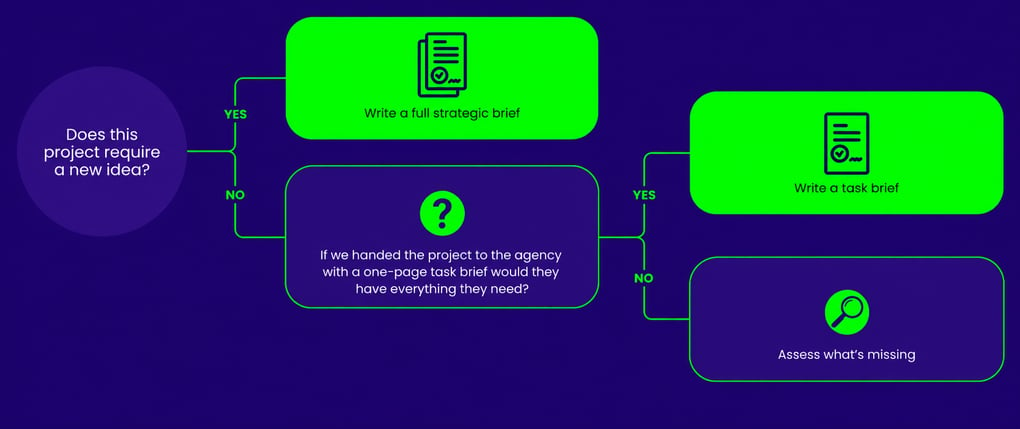
- - One question decides: does this project require a new idea? If yes, write a strategic brief. If no, a task brief will do.
- - A task brief is a short, prescriptive document for executional work — resizes, adaptations, or new executions of an existing campaign. It covers the campaign reference, deliverable specs, the message (already defined), and the deadline.
- - A strategic brief is needed when work requires fresh creative thinking: a new audience, touchpoint, cultural moment, or objective.
- - Over-briefing wastes time. Under-briefing erodes campaign platforms.
Not all briefs are created equal. How do you know when a brief deserves time and rigour to get right, and when it just needs to get out the door?
There’s an inconvenient truth at the heart of what we write about at BetterBriefs. While we spend our days espousing the value of good briefs and the importance of getting them right, there’s one thing we don’t often talk about: the fact that not every brief actually needs to be great.
A lot of what agencies produce every week isn’t fresh work or a new campaign. It might be another execution of an existing campaign. A resize. An adaptation from global. A product update.
Spending two weeks sweating over strategic direction for a 300x250 banner isn’t the best use of anybody’s time. So how do you know when rigour matters and when you should just get on with it?
We regularly see in our work training marketers globally that teams either over-brief executional work or under-brief genuinely strategic decisions.
The question that decides everything
One question separates work that needs a proper strategic brief from work that doesn’t:
Does this project require a new idea?
If yes, you need a full strategic brief. If no, a task brief will do. It’s that simple. And yet it’s a distinction many agencies and marketing teams rarely make explicitly, which is why teams either over-brief executional work or under-brief genuinely strategic decision-making. Both are expensive mistakes.
What's a task brief?
A task brief – sometimes called a ‘tactical’ brief, a ‘production’ brief or simply a ‘job’ brief – is a short, practical document that gets executional work done without reinventing the wheel.
It’s instructional and prescriptive. A task brief doesn’t ask agencies to think about strategy, audience or message. Those decisions have already been made. A task brief simply says: here’s the existing idea or asset, here’s the deliverable, here’s the deadline. Go!
At its most basic, it covers the campaign reference, the deliverable and specs, the message (already defined), and the deadline.
What triggers a ‘proper’ brief?
Any brief that requires new creative thinking needs the full treatment, even when it sits within an existing campaign.
A new touchpoint, a new audience, a new cultural moment, a new product or a new strategic objective all require fresh creative thinking. You can’t do that with a task brief.
Still not sure where the line lies? Let’s look at some examples.
Uber Eats’ “Get Almost, Almost Anything” platform humorously visualises all the things it can and can't deliver to make people realise just how much it actually can deliver beyond food.
All executions follow a well-established executional format: unexpected thing you can’t get? No. Something you can? Yes. 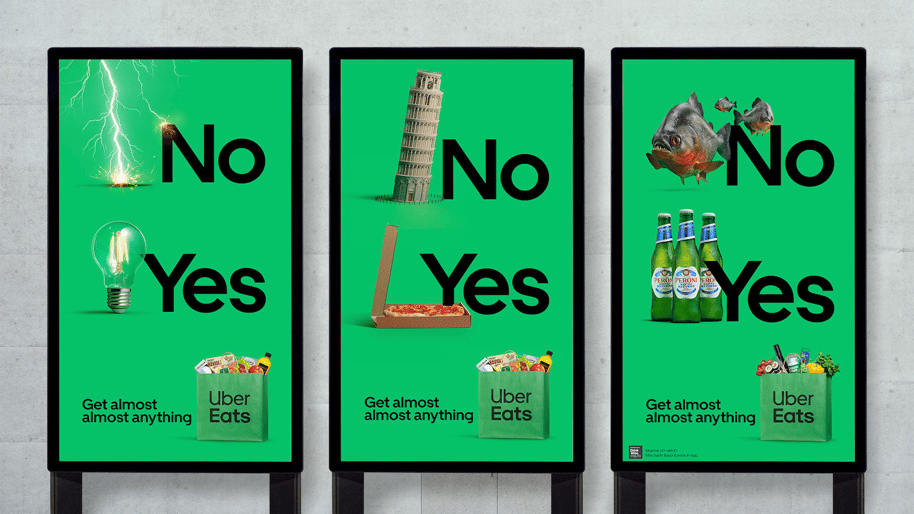
If that campaign required a new execution in that format – same structure, new product – it would only need a task brief, not a new strategic document.
But when Uber Eats takes on another year of a major sponsorship (e.g. Australian Open), they would need a full strategic brief. New context, new audience mindset, potentially new objectives. What does the brand want to say in a live sport environment, to whom and why? The existing campaign platform might carry across, but the strategic thinking has to start fresh.
If you’re a bank rolling out more executions of your existing brand campaign across digital formats, you just need a task brief. But if you’re briefing a campaign to attract first-time mortgage customers, even under the same brand umbrella, you need a real brief. New audience, new insight, new message.
Or simply: resizing a TV ad to fit social formats? Task brief. Creating the social campaign that launches alongside it? Proper brief.
The cost of getting it wrong
Under-briefing strategic work can lead to an opportunity missed or poor work. The original creative thinking can get diluted, messages get muddled, and the work ends up halfway between two ideas. This is how great campaign platforms sometimes get slowly eroded.
Over-briefing executional work wastes time, the most expensive resource in any agency or marketing department. It also frustrates creative teams who don’t need another strategy session to produce work they’ve been asked to replicate.
A good brief can be one of the most powerful tools in marketing. Just make sure you know when and how to use it.
Q: What’s the difference between a strategic brief and a task brief?
A: A strategic brief is for work requiring a new idea; a task brief is for executing an existing idea without redoing strategy.
Q: When do I need a full strategic brief?
A: When there’s a new audience, objective, product, context, channel role, or cultural moment that changes what the work must achieve.
Q: What happens if I use the wrong type of brief?
A: Over-briefing wastes time; under-briefing dilutes strategy, muddles messages, and weakens campaign platforms.
Pieter-Paul von Weiler is the co-founder of BetterBriefs, an advisory and training business that helps marketers write better briefs and deliver more impactful ideas. A highly awarded former agency strategist, having worked at Publicis Amsterdam, Publicis London, Saatchi & Saatchi and AJF Partnership. Pieter-Paul has served as an Effie judge across Australia and APAC for over a decade.
Together with co-founder Matt Davies, he wrote the BetterBriefs Project and The Best Way for a Client to Brief an Agency, a practical guide for marketers to improve the quality of briefs, co-authored by Mark Ritson and published in partnership with the Institute of Practitioners in Advertising (IPA). Pieter-Paul (together with Matt) also led the BetterIdeas Project, a global study exposing the poor state of the creative evaluation process. The study aims to improve the creative decision-making and evaluation practices and was launched in partnership with the World Federation of Advertisers (WFA) and the IPA.